
There’s nothing quite like a hot summer day by the pool: 90-degree weather, cold drinks, accessible shade, and zero responsibilities. For the swimmer, amenities like sunblock and a chance to cool off make the experience. But for pool professionals, the real magic that makes this worry-free environment possible happens behind the chemistry, by maintaining precise proper disinfectant, pH, and Cyanuric Acid (CYA) levels to achieve safe, clean and clear water.
Think about sunscreen. If you forget it, you might end up looking like a boiled lobster. If you apply way too much, you might look like a freshly powdered donut, perfectly safe from the sun, but not safe from being teased at the barbecue.
Every summer, the chlorine in outdoor pools faces these exact scenarios. Too little CYA (sun protection) means you can dump extensive amounts of sanitizer into the water, only for the sun to obliterate it before lunch. Conversely, too much CYA "over-protects" the chlorine, crippling its ability to fully sanitize the pool. The science behind this balance is the foundation of smart proactive pool care.
How Chlorine Meets Water
To understand why CYA is instrumental in outdoor pools, we first must look at what happens when chlorine meets water on its own.
Adding liquid chlorine for instance, provides the most instantaneous form of disinfection. It bypasses prolonged dilution times and immediately creates a pure, unbound stream of Hypochlorous Acid (HOCl), the highly active, killing form of chlorine that destroys bacteria and algae.
Sodium hypochlorite + water → Hypochlorous acid + Sodium Hydroxide
Other non-stabilized options, like calcium hypochlorite (cal-hypo), also deliver pure HOCl without adding CYA, though they must physically dissolve first (and they bring calcium along for the ride).
Because these non-stabilized chlorines don't sneak any hidden stabilizer baggage into your pool, they are the gold standard for pure fast sanitation control. However, delivering that pure HOCl comes with a tradeoff: without CYA, the HOCl is completely naked, exposed, unprotected against sunlight.
There is also a massive myth surrounding liquid chlorine's impact on pH. People often believe sodium hypochlorite permanently raises pH because it produces sodium hydroxide (NaOH, or lye) when added to water. While you will see a temporary spike in pH upon application, that effect is completely neutral over time. The moment that hypochlorous acid goes to work—either by oxidizing contaminants or breaking down under UV light—it produces hydrochloric acid (HCl), which naturally neutralizes the NaOH right back to salt and water.
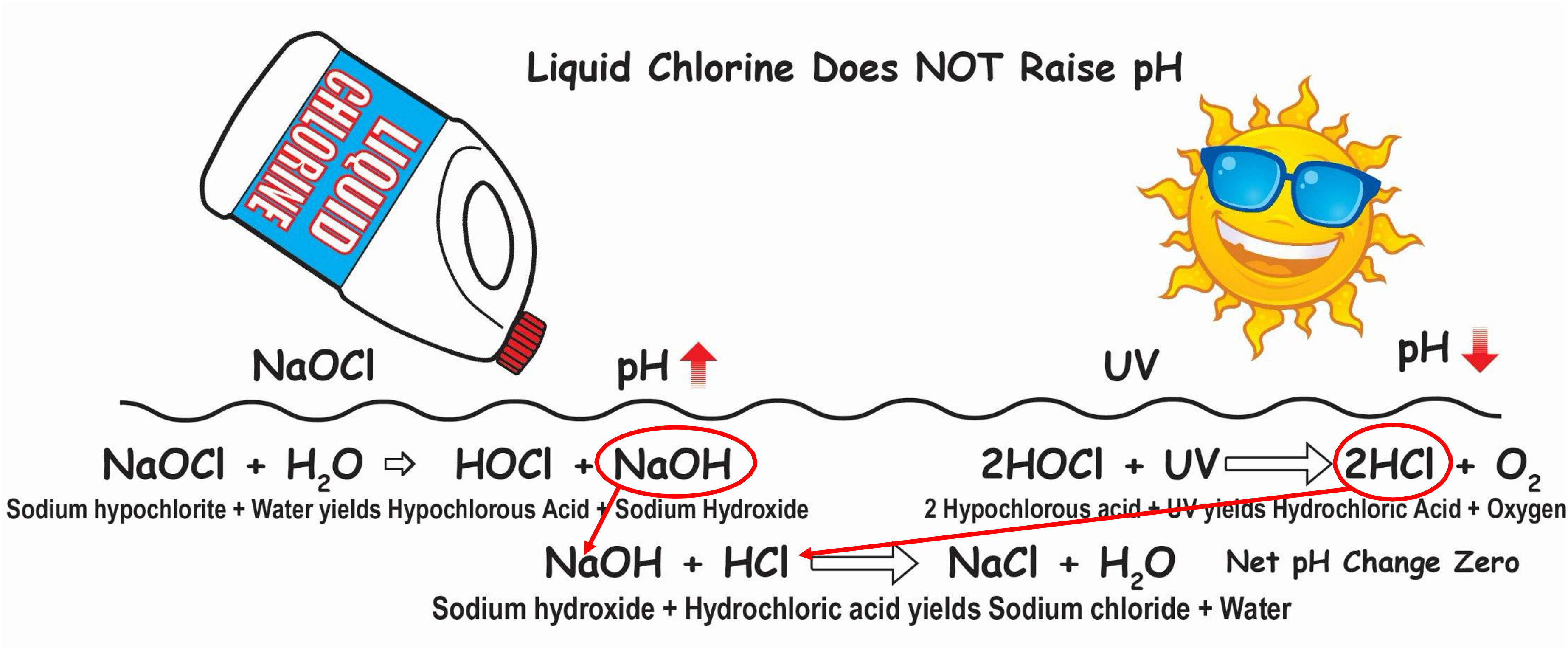
The important distinction here is patience: this neutralization happens naturally. Reaching for a jug of acid to correct that initial, temporary pH bump will actually drive your pH too low once the chlorine does its job.
How pH Controls Chlorine (before CYA takes over)
When chlorine is active in the water, your pH level acts as the commander deciding what form that unbound sanitizer takes. As pH climbs, active hypochlorous acid (𝐻𝑂𝐶𝑙) sheds a hydrogen ion and transforms into its weaker chemical counterpart: the Hypochlorite Ion (𝑂𝐶𝑙−).
Think of these two forms as different ranks in an army. HOCl is your battle-tested, elite General—it’s fast, highly effective, and kills pathogens in seconds.OCl-, on the other hand, is a green, raw recruit who hasn't even learned to lace up their boots. It is incredibly slow and can take 70 to 80 times longer to eliminate the exact same microbe. This ratio shifts dramatically with your pool's chemistry:
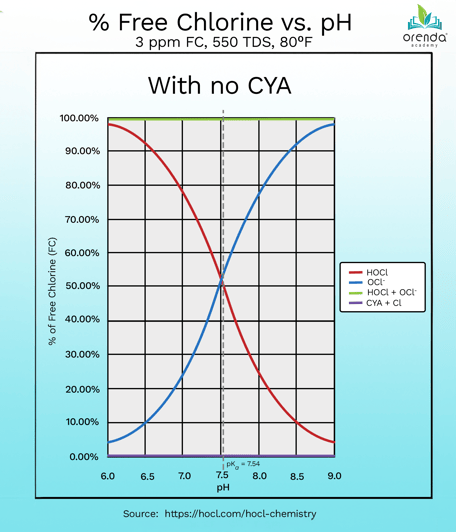
This graph shows the equilibrium between HOCl and OCl- at 3 ppm of free chlorine, 550 ppm TDS, 80-degree water, and no CYA.
The red line represents % of HOCl, and the blue % of OCl-
At 7.2 pH: About 65% of the chlorine stays in the elite General HOCl form.
At 7.5 pH: We have a roughly 50/50 split.
At 7.8 pH: Nearly 70% of the chlorine is forced into a demotion, taking the form of the weaker recruit (OCl- )
Another critical difference between the two ranks is how they handle the sun. While both are vulnerable to ultraviolet (UV) radiation, they absorb light differently. OCl- absorbs UV rays (specifically around the 292 nm wavelength) much more efficiently than HOCl does. Because it is a better "magnet" for this light, OCl- degrades about 4 times faster under direct sunlight than its HOCl counterpart.
In bright, direct sunlight, UV rays will destroy up to 75% to 90% of your pool's unprotected free chlorine in less than two hours, and the higher the pH the faster this can occur.
Think about the economics of that for a second. You spend hard-earned money on chlorine, pour it in the pool in the morning and by noon the sun has incinerated nearly all of it. You aren't sanitizing the water; you're just paying tribute to the sun. Understanding how CYA works is essential to remediate the situation.
The Molecular Umbrella
Chemically, Cyanuric Acid (CYA) features a symmetrical ring structure that forms a weak, reversible bond with chlorine in pool water. Acting as a molecular umbrella, CYA binds to most of the chlorine—creating compounds known as chlorinated isocyanurates—which effectively shields the chlorine from UV destruction. It securely holds this massive reserve, leaving only a tiny fraction exposed and unprotected in the water as active HOCl and OCl-.
This exact chemical mechanism is why the industry relies heavily on pre-stabilized chlorine products, which physically combine the chlorine and the CYA "umbrella" into a single compound.
The most common form is Trichlor, trichloroisocyanuric acid, which is typically pressed into slow-dissolving tablets or pucks.
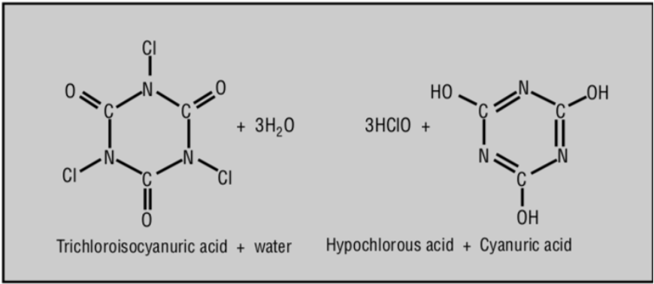
When the Trichlor molecule interacts with water, it produces both active HOCl and CYA. However, there is a major catch to this convenient delivery system. As the chlorine goes to work sanitizing and eventually gets consumed, the chemical reaction leaves behind two persistent byproducts.
First, it leaves a heavy load of free hydrogen ions (H+), which gives Trichlor an incredibly acidic pH of 2.8 to 3.0, depending on product’s % concentration, and persistently drags down your pool's pH and total alkalinity over time.
Second—and most critical—is the CYA itself. Unlike chlorine, CYA doesn't burn off in the sun or get consumed. Every Trichlor tablet you add leaves a permanent deposit, making it incredibly easy for your stabilizer levels to rapidly over-accumulate. Before long, that protective umbrella turns into a straightjacket, "over-protecting" the chlorine and crippling its ability to sanitize.
Conversely, Dichlor is another popular pre-stabilized option, typically sold as a fast-dissolving granular powder used for shocking. While Dichlor delivers the same HOCl and CYA combination, it is chemically manufactured as a sodium salt. The inclusion of this sodium acts as a buffer during the chemical reaction, preventing that heavy release of hydrogen ions. As a result, Dichlor is nearly pH neutral (around 6.5 to 7.0), allowing you to deliver a rapid dose of stabilized chlorine without tanking your pool's pH balance.
The Ultimate Balancing Act: Chlorine, CYA, and pH
Without CYA’s influence, pH acts as the sole commander, controlling how many elite Generals (HOCl) versus raw recruits (OCl-) are on the battlefield. However with CYA present, the actual amount of active troops on the front lines is no longer just about pH; instead, it is dictated almost entirely by the ratio between the CYA and the total free chlorine levels. This vital ratio controls exactly how many troops are actively fighting at any given moment, and as those front-line soldiers are consumed, the CYA "barracks" automatically releases more unbound chlorine to replenish the ranks.
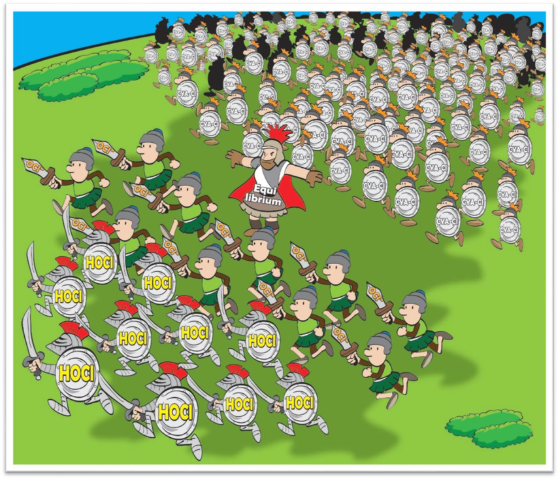
To put this into perspective, let's look at a pool with 30 ppm of CYA and 3 ppm of free chlorine, under the same previous conditions.
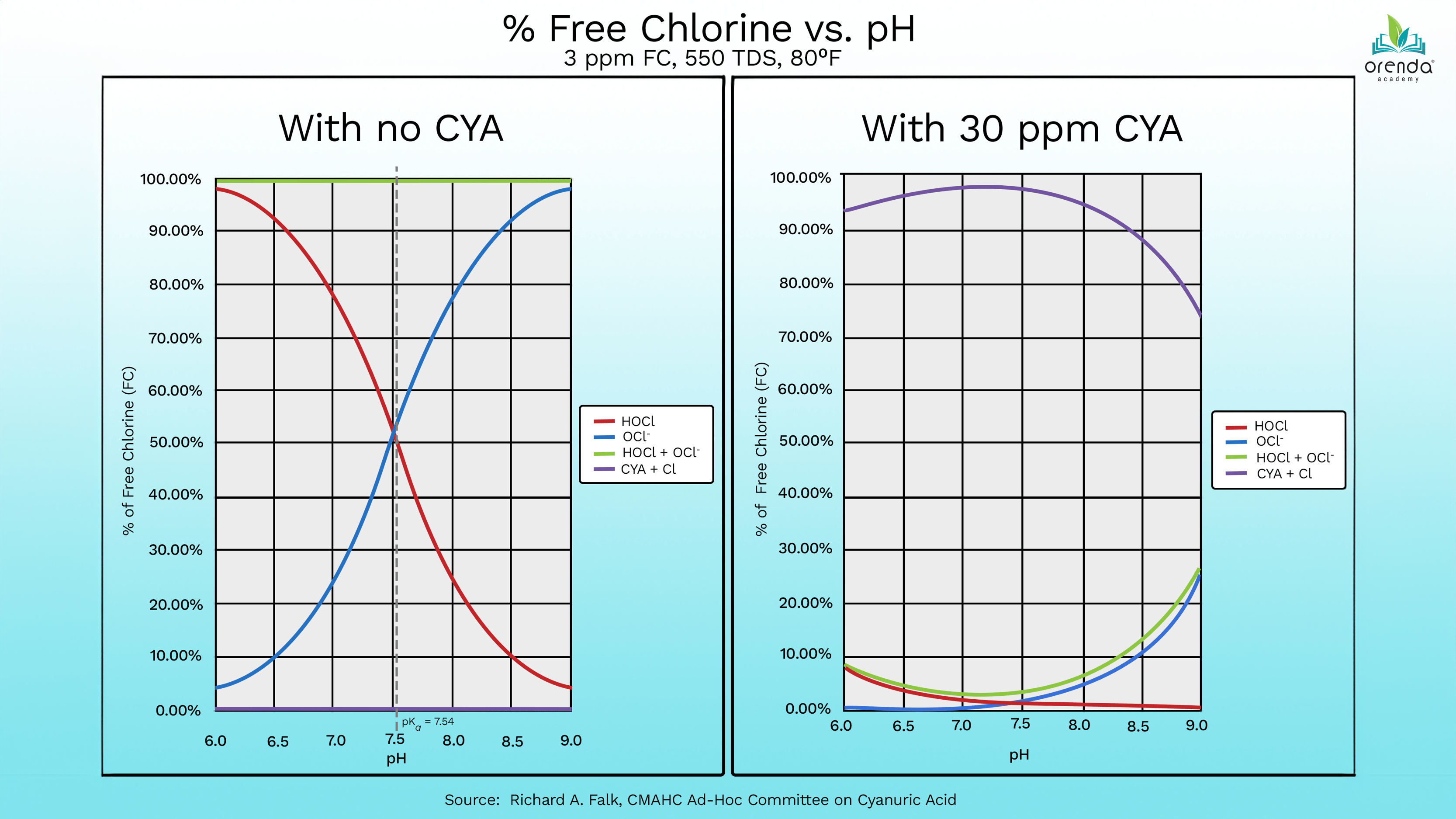
Notice in the right graph how the purple line, which represents the chlorine bound to CYA, only varies slightly between 95% and 97% across a normal pH range of 7.2 to 7.8. This means only the remaining 3% to 5% of your total chlorine is left unbound as active HOCl and OCl- (represented by the red and blue lines). At a balanced 7.5 pH, this active fraction splits 50/50, leaving your actual, hard-working HOCl at a roughly microscopic level of 0.05 ppm or basically the 1.5% of 3 ppm, to actively patrol and sanitize the water.
You will also notice a slight drop in that purple line as the pH increases, or conversely a raise in the blue line or an increase in the OCl- concentration. This is a direct consequence of more OCl- becoming active versus HOCl. Because OCl- absorbs more UV light and degrades faster, it creates a much heavier drain on your chlorine reserves. Conversev
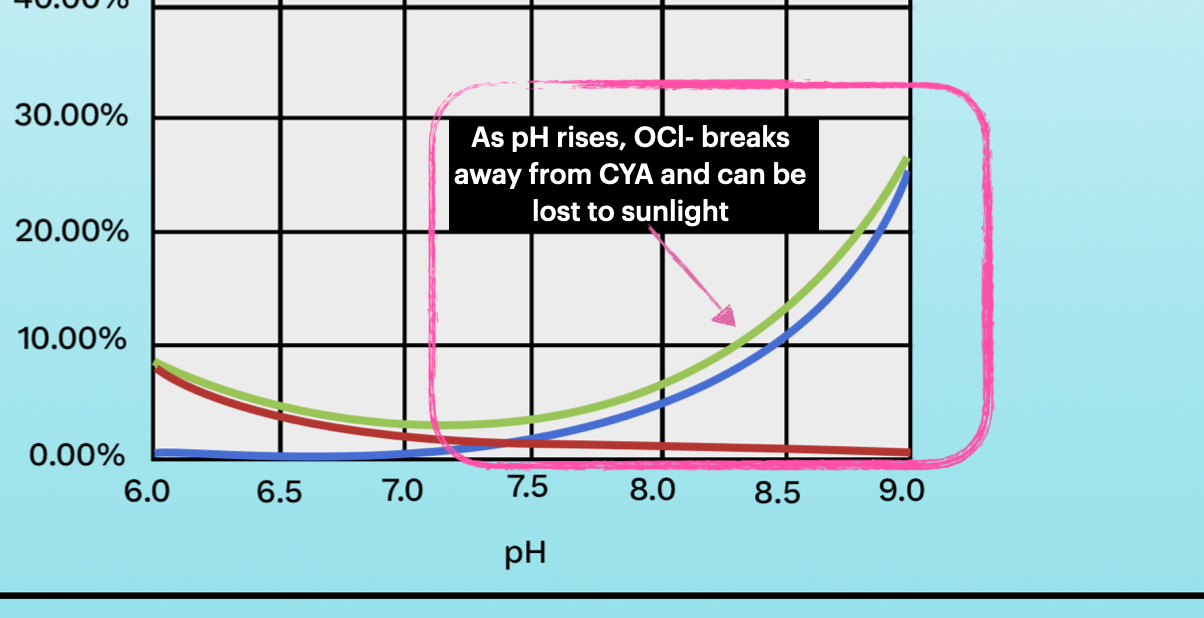
The story doesn’t end there. Because active sanitizing power is strictly dictated by the ratio of free chlorine to CYA, a dangerous trap forms when maintenance habits remain static while the chemistry shifts. If you habitually keep your free chlorine fixed at a standard target—say, 3 ppm—but your CYA is steadily accumulating over time, that rising CYA will bind to an increasingly higher percentage of your chlorine. This crushes your ratio, shrinking the active HOCl and OCl- fraction down to an even more microscopic level and inevitably leading to a severe lack of proper disinfection.
.png?width=1920&height=1080&name=HOCl%20vs%20OCl%20at%20different%20CYA%20values%20(1).png)
The Perfect Storm
Depending solely on Trichlor tablets relentlessly drives up Cyanuric Acid (CYA). While this offers necessary sun protection, it severely binds the active fighting chlorine (HOCl). Standard test kits mask this lockup because their chemical reagents strip the chlorine away from the CYA during the testing process. This lumps the massive, locked-up reserve and the tiny fraction of active sanitizer together into a single "Free Chlorine" reading, creating a dangerous false sense of security.
To prevent algae, baseline chemistry dictates maintaining a Free Chlorine level equal to at least 7.5% of your total CYA. However, surviving the intense summer sun and heavy bather loads means the required ratio is actually closer to 10% to 11% of the CYA. Once CYA creeps past 150 ppm, hitting a 15+ ppm chlorine baseline becomes a major concern for bather comfort and safety, as well as an unrealistic financial burden.
This lockup creates a frustrating illusion: a test kit reads a "healthy" 4 ppm of chlorine, yet the pool still turns green. Desperate to clear the water, people often resort to algaecides. While algaecides bypass the CYA trap entirely, leaning on them as a continuous crutch leads to severe secondary issues like excessive foaming, disrupted chemical balances, and permanent metal stains.
Proactive Management
Avoiding this chemical trap requires treating CYA as a strategic tool rather than a default habit. By shifting to a proactive management approach, you can break the cycle and keep the water safe, clean, and clear despite the time of the season, and usage.
-
Test CYA Routinely: Never let a standard chlorine reading blind you to an underlying lockup. Know your stabilizer number.
- Build a Liquid Baseline: Prime the pool with unstabilized liquid chlorine for a fast-acting HOCl boost that won't drive up your stabilizer levels.
- Use Tablets Tactically: Stop using Trichlor as the sole sanitizer. Use tablets strictly to meter out a maintenance dose—such as when you go on vacation or when your CYA actually needs a bump.
- Reduce the Oxidant Demand: Chlorine shouldn't do all the heavy lifting. Use enzymes to break down non-living organic waste (like sunscreen and sweat) and use phosphate removers to eliminate impure micronutrient loads. Clearing this demand frees up your chlorine's bandwidth to focus purely on killing pathogens.
- Respect the Ratio: Always dynamically adjust your Free Chlorine target to match the water's current CYA level.
Ultimately, delivering safe water is about mastering this invisible equilibrium. By managing your CYA intentionally, reducing the organic demand on your sanitizer, and respecting the ratio, you ensure your chlorine is always ready for battle—giving you the worry-free summer oasis you deserve.